Sandustry Automation Guide: First Gold Factory
Build your first Sandustry automation line: turn Sand and Water into Wet Sand, route Gold and Residue, fix blockages, and move Water through pipes.
Your first Sandustry automation line turns Sand and Water into Wet Sand, drops that Wet Sand onto Shakers, sends Gold into a Collector, and moves Residue away from the processing surface. The line only keeps running when every material has a clear route: Sand to Water, Wet Sand to Shakers, Gold to storage, and Residue to a separate exit. Start with a small feed so you can see where material stops before scaling the factory.
This guide covers the current Early Access foundation of a Sandustry factory. It focuses on the first Gold production chain, solid logistics, Filter sorting, basic recirculation, Water transport, and the failures that stop those systems.
Quick Automation Loop
The first production chain is:
Sand → add Water → Wet Sand → Shaker → Gold + Residue
The outputs then split:
- Gold → Collector, where it becomes available for Research.
- Residue → separate exit or storage, so it does not cover the Shakers.
The current official material pages describe the basic reaction as 1 Sand pixel + 1 Water pixel → 2 Wet Sand pixels. Gold output from Shakers is probabilistic, so this relationship should not be turned into a fixed Gold-per-minute promise.
Automation depends on flow, not just machine placement. A Shaker can be present and active while the factory still fails because Wet Sand misses its top surface, Residue has nowhere to go, Gold never reaches a Collector, or the Water source is empty.
Build Your First Gold Line
Build the smallest version of the complete loop before adding more Shakers or faster input.
- Prepare a controlled Water area. Use a pool or reservoir where you can see the Water level and recover the Wet Sand.
- Feed Sand into Water. Sand and Water must touch to create Wet Sand. Water is consumed during this reaction.
- Move Wet Sand onto the top of the Shakers. Test a small batch and confirm it stays on the processing surface.
- Give Gold a clear path into a Collector. Gold can pass through a Shaker, but it only becomes spendable Research currency while it is inside Collector tiles.
- Give Residue a separate exit. Residue remains above the Shaker and moves away slowly. A blocked exit lets it cover the processing surface.
- Keep the initial feed observable. If material starts piling up, reduce the input before changing the layout.
- Add logistics after the loop works. Use Conveyor Belts, Launchers, and Filters to solve a visible movement or sorting problem—not to hide an unstable process.
There is no required number of Shakers for this first line. The right size depends on how quickly Wet Sand arrives and whether Residue can leave without blocking the input.
Move Solids with Conveyors and Launchers
Each early logistics block has a different job.
| Component | What it does | What it does not do |
|---|---|---|
| Conveyor Belt | Moves solid pixels horizontally in its travel direction. | It cannot move a blocked bottom layer or create more processing capacity. |
| Launcher | Lifts solid pixels and can throw them to the side at the top of a Launcher column. | It does not sort mixed materials or guarantee a clear landing area. |
| Collector | Makes Gold inside its tiles available as Research currency. | It does not process Wet Sand or move materials into its tiles. |
| Filter | Separates one selected solid material with an Allow or Block rule while moving other solids like a Conveyor Belt. | It does not increase Shaker throughput or create Water. |
Conveyor Belts directly move the pixels touching the belt. If the bottom pixel cannot move forward, the pile above it also stops. Check the end of a belt before adding more input; a full pit, wall, blocked Filter outlet, or stalled Launcher can stop the entire upstream line.
Use a Launcher when material must rise or leave a line sideways. Make sure its output has somewhere to land and continue moving. Neither Launchers nor Conveyor Belts are universally better—the useful choice depends on the direction and destination of the material.
Separate and Recirculate with Filters
A basic Filter sorts one selected solid material in one of two ways:
- Allow: the selected material falls through the Filter; other solids continue along it.
- Block: the selected material stays on the Filter path; other solids are allowed through.
Test a Filter with a small, visible sample before connecting it to the full factory. Confirm which material falls through, where it lands, and whether the continuing path has an open exit.
Useful early sorting decisions include:
- Letting Gold fall toward a Collector while other solids continue.
- Pulling Residue away from a Shaker return line.
- Sending dry Sand back to the Water area instead of into the Shaker feed.
- Returning unprocessed Wet Sand to the Shakers after the blocking material has been removed.
Recirculation means returning material that still needs processing instead of discarding it. It is a design pattern, not a required blueprint. Before building a loop, identify why the material escaped processing. A return belt will not fix a covered Shaker, an excessive feed rate, a reversed Filter rule, or an output with no free space.
Keep return paths specific. Dry Sand should return to Water; Wet Sand should return to an available Shaker surface; Residue should leave through its own route. Sending every material around one closed loop can reproduce the original blockage.
Diagnose Factory Blockages
Start at the final output and work backward. Many apparent machine failures are actually full exits or mixed-material piles.
| Symptom | Likely cause | What to check |
|---|---|---|
| Residue covers the Shaker | Residue remains above the Shaker and its exit is blocked or too slow for the current feed. | Reduce Wet Sand input, clear the top and side exit, then route Residue away separately. |
| Wet Sand falls past processing | It is missing the top surface, moving through too quickly, or landing on a covered Shaker. | Watch one small batch, confirm the landing point, and clear Residue or other solids first. |
| Dry Sand enters the Wet Sand line | Sand reached the processing route before touching enough Water, or a return line mixed the materials. | Separate Sand from Wet Sand and send the dry Sand back to the wetting area. |
| A Conveyor pile stops moving | The bottom layer or the end of the route has no free destination. | Inspect the belt end, Filter outlet, Launcher input, and the bottom of the pile before changing belt speed. |
| Feed grows faster than the Shakers process it | Wet Sand arrives faster than the available Shaker surface and Residue exit can handle. | Lower the feed, expose the Shaker tops, clear Residue, and only then add processing area if needed. |
| A Filter sends the wrong material | Allow and Block are reversed, or the target material is not reaching the Filter surface. | Test the rule with a small sample and verify both the drop path and continuing path. |
| Material has no exit route | The destination is full, enclosed, or blocked by another solid. | Clear the last destination first, then follow the route upstream until movement resumes. |
| The factory stops making Wet Sand | The Water source may be depleted, or Water is not reaching the wetting area. | Check the source level first, then inspect the Pump, Pipe connection, Liquid Vent, and destination space. |
Do not assume every slowdown has one cause. For example, Wet Sand beside a Shaker may indicate a bad landing point, a covered surface, excessive feed, or a blocked downstream route. Observe the material before choosing a fix.
Move Water with Pumps, Pipes and Liquid Vents
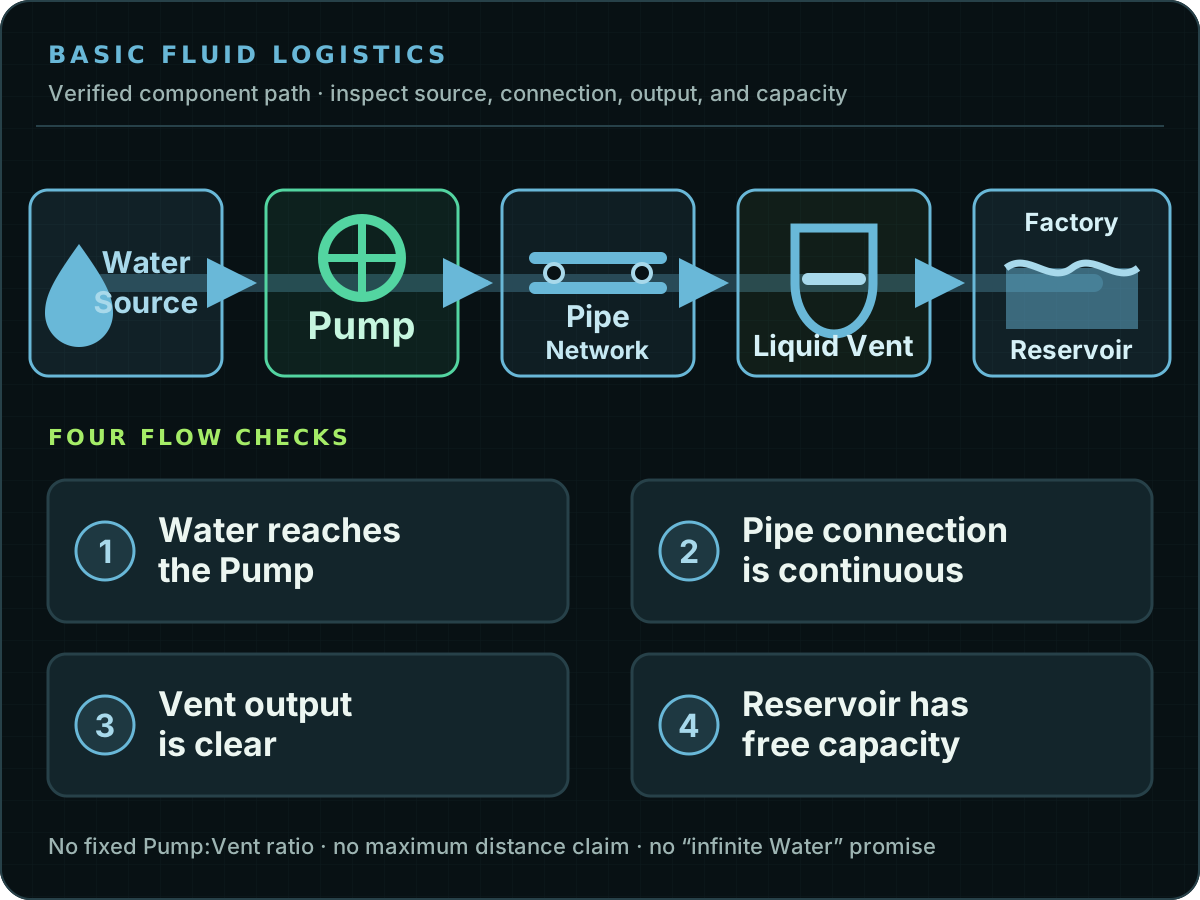
The basic fluid route is:
Water source → Pump → Pipe → Liquid Vent → factory reservoir or washing area
- A Pump takes non-Lava liquid from the area it can reach inside its tile and sends it into connected Pipes.
- A Pipe creates the continuous network between the Pump and Liquid Vent.
- A Liquid Vent releases the supplied Water at the destination.
Place the Pump where its effective pickup area touches usable Water. Solid pixels can occupy space inside the Pump and prevent liquid from entering, even when the Pump appears to be in the pool. If flow stops, inspect it for Sand, Gold, Seeds, or other solids rather than assuming the Pipe is broken.
Run a continuous Pipe from the Pump to the Liquid Vent. At the destination, leave room around the Vent’s output. Rising Water or loose material can obstruct the release area and stop the apparent flow. A built network still needs an available source, an unobstructed input, a connected path, and an open output.
After construction, observe a small transfer. Confirm that the source level falls, Water appears at the destination, and the receiving area can contain it. The current official documentation does not establish a universal Pump-to-Vent ratio, maximum useful height, or best number of Pumps for every factory.
Water Supply and “Infinite Water”
Water is consumed when Sand becomes Wet Sand, so expanding the Sand feed also increases Water demand. When production slows, check the system in this order:
- Source: Is there still Water touching the Pump’s effective pickup area?
- Pump: Has a solid pixel occupied the input space?
- Pipe: Is there a continuous connection to the correct Vent?
- Liquid Vent: Is its output covered by material or the destination Water level?
- Demand: Is the factory consuming Water faster than the current source supplies it?
Steam rising and returning as Rain is a normal Water mechanic. The official Beginner’s Guide also says that enough Lumlings in one place can provide a small but constant supply of Water. Neither statement guarantees unlimited throughput for every layout.
Some player builds are described as infinite because they can maintain a small renewable supply, but that does not mean unlimited throughput. Whether a system is sustainable depends on its Water production, storage, delivery, and the amount consumed by Sand and other processes.
Automation FAQ
How do you automate Gold in Sandustry?
Turn Sand and Water into Wet Sand, deliver the Wet Sand onto Shakers, let Gold fall into a Collector, and move Residue away through a separate exit. Add Conveyor Belts, Launchers, and Filters only where movement or sorting requires them.
Why is Residue blocking my Shakers?
Residue stays above the Shaker and leaves more slowly than Gold. Reduce the Wet Sand feed, clear the Shaker surface, and make sure Residue has an open side route before expanding the line.
Why is Wet Sand bypassing the Shakers?
It may be missing the top surface, arriving too quickly, or landing on Residue or another obstruction. Test a small batch and watch the exact landing point before changing the factory.
What does a Filter do in Sandustry?
A Filter separates one selected solid material. Allow lets that material fall through; Block keeps it on the Filter path while other solids fall through. It sorts flow but does not increase machine throughput.
How do Pumps and Pipes work?
A Pump takes available liquid into a connected Pipe network, and a Liquid Vent releases it at the destination. The Pump needs accessible Water, the Pipe must be continuous, and the Vent needs open output space.
Can you make infinite Water in Sandustry?
You can build renewable Water systems using normal mechanics such as Steam and Rain, and Lumlings can provide a small constant supply. That is not the same as guaranteed unlimited Water; sustainable output depends on the design and consumption rate.
Related Guide
If you have not completed the opening tutorial systems yet, start with the Sandustry Beginner Guide before scaling this factory loop.
Sources
- Official Wiki — Beginner's Guide
- Official Wiki — Sand
- Official Wiki — Water
- Official Wiki — Wet Sand
- Official Wiki — Gold
- Official Wiki — Residue
- Official Wiki — Shaker
- Official Wiki — Collector
- Official Wiki — Conveyor Belt
- Official Wiki — Launcher
- Official Wiki — Filter
- Official Wiki — Pump
- Official Wiki — Pipe
- Official Wiki — Liquid Vent
- Gameplay — Factorio Expert plays Sandustry (00:20–02:41; 08:34–09:44)
- Gameplay — I Need More Physics-Based Factory Builders! (00:59–20:57; 46:47–50:23)
- Gameplay — I Built My First Pipes & Pumps System! (22:50–35:04; 54:20–1:02:39)
- Gameplay — I Found an INFINITE Water Source! (16:32–26:40; 49:28–51:23)